
What is a SWOT confrontation matrix? #
The SWOT confrontation matrix is a marketing model in which the market and the organisation are confronted with one another. This matrix ‘confronts’ the most important strengths and weaknesses of the organisation with the most important opportunities and threats from the market. This allows you to read from the SWOT matrix how well your organisation aligns with the market. This is also referred to as ‘market fit’. The outcomes are important for determining the marketing strategy.
SWOT analysis example #
The SWOT analysis and the confrontation matrix are inextricably linked and together form the heart of every strategic marketing plan.
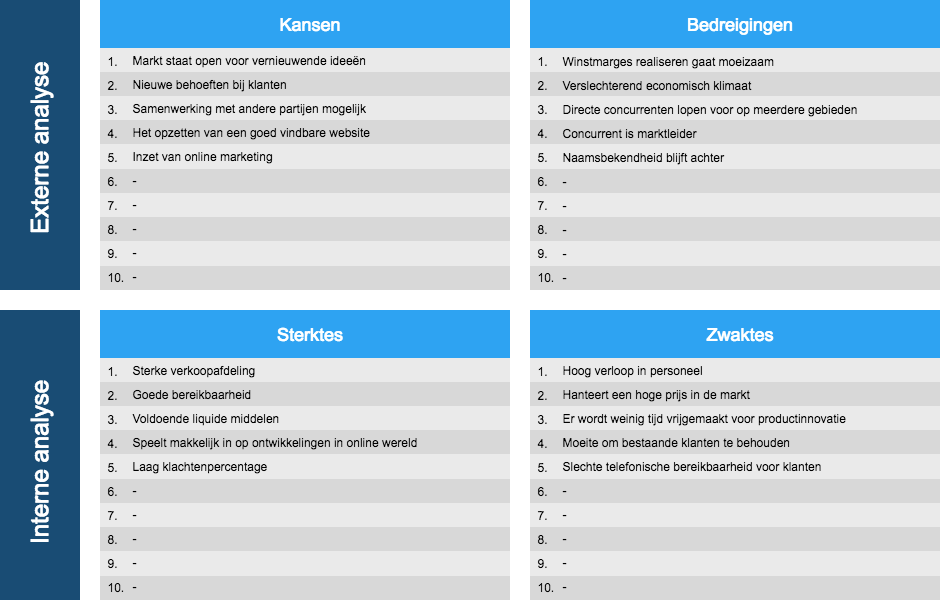
The SWOT analysis examines the strengths and weaknesses within the organisation at the micro level, and the opportunities and threats in the market at the meso and macro level. This is done using the internal analysis, also known as the strengths and weaknesses analysis, and the external analysis. This results in a clear SWOT model that can be ranked in order of importance.
Confrontation matrix example #
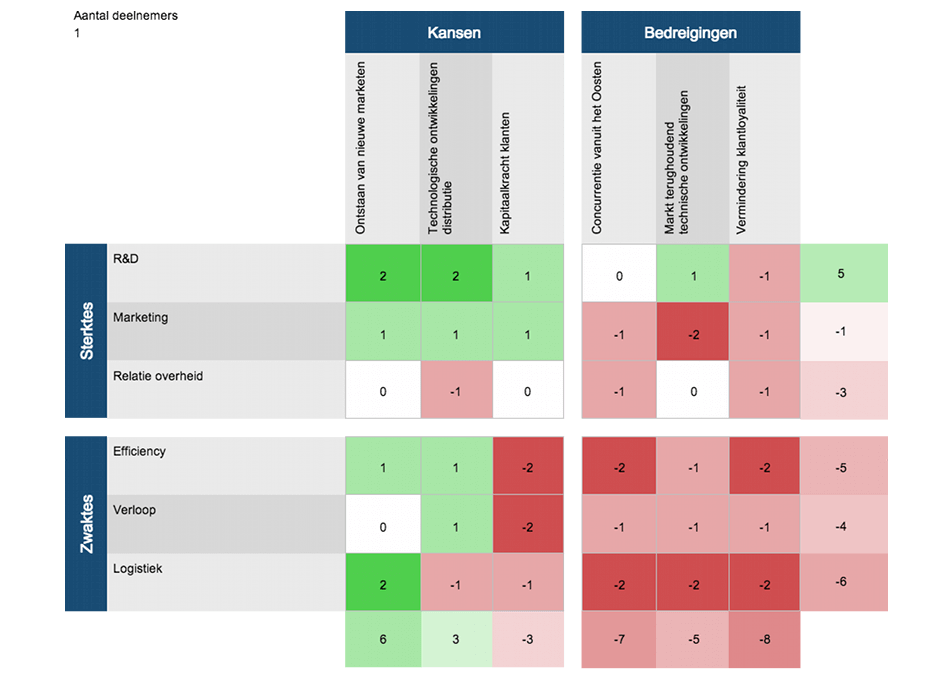
The SWOT analysis provides the input for the confrontation matrix, also known as the SWOT matrix. Once you have ranked the various elements of the SWOT analysis in order of importance, you take the top 3 into the confrontation matrix. This gives you 3 strengths, 3 weaknesses, 3 opportunities and 3 threats.
This keeps your confrontation matrix clear and makes it easier to derive strategic issues. When determining the marketing strategy (the step that follows the confrontation), you do take all outcomes from the SWOT analysis into account. However, for the confrontation matrix you limit yourself to the most important 3 for the sake of clarity.
Creating a confrontation matrix #
The confrontation matrix or SWOT matrix ‘confronts’ strengths with opportunities, strengths with threats, weaknesses with opportunities, and weaknesses with threats. This involves the following four questions:
- Does this strength enable the organisation to capitalise on this opportunity?
- Does this strength enable the organisation to counter this threat?
- Does this weakness prevent the organisation from capitalising on this opportunity?
- Does this weakness prevent the organisation from countering this threat?
Each of these questions is answered individually with ‘very positive’ (+2), ‘positive’ (+1), ‘neutral/no relation’ (0), ‘negative’ (-1) or ‘very negative’ (-2).
As you can see in the confrontation matrix example, the numbers correspond to the answers and are immediately assigned a colour. Green indicates a positive market fit, while red indicates that improvement is possible. The darker the colour, the more pronounced the outcome in the confrontation matrix. This makes it very easy to see how and where improvements are needed within the organisation, and to adjust your marketing strategy accordingly.
The colours are automatically calculated by the SWOT matrix generator.
From SWOT model to SWOT matrix #
The entire process from SWOT analysis to confrontation matrix is briefly summarised in this two-minute video. This overview is indispensable in every marketing plan and for every marketer.
Visit Marketingbright Academy for creating a SWOT analysis and other marketing models.
Start today with building your SWOT matrix to gain new insights into your alignment with the market. Use the tools and templates from Marketingbright Academy for step-by-step guidance.


